
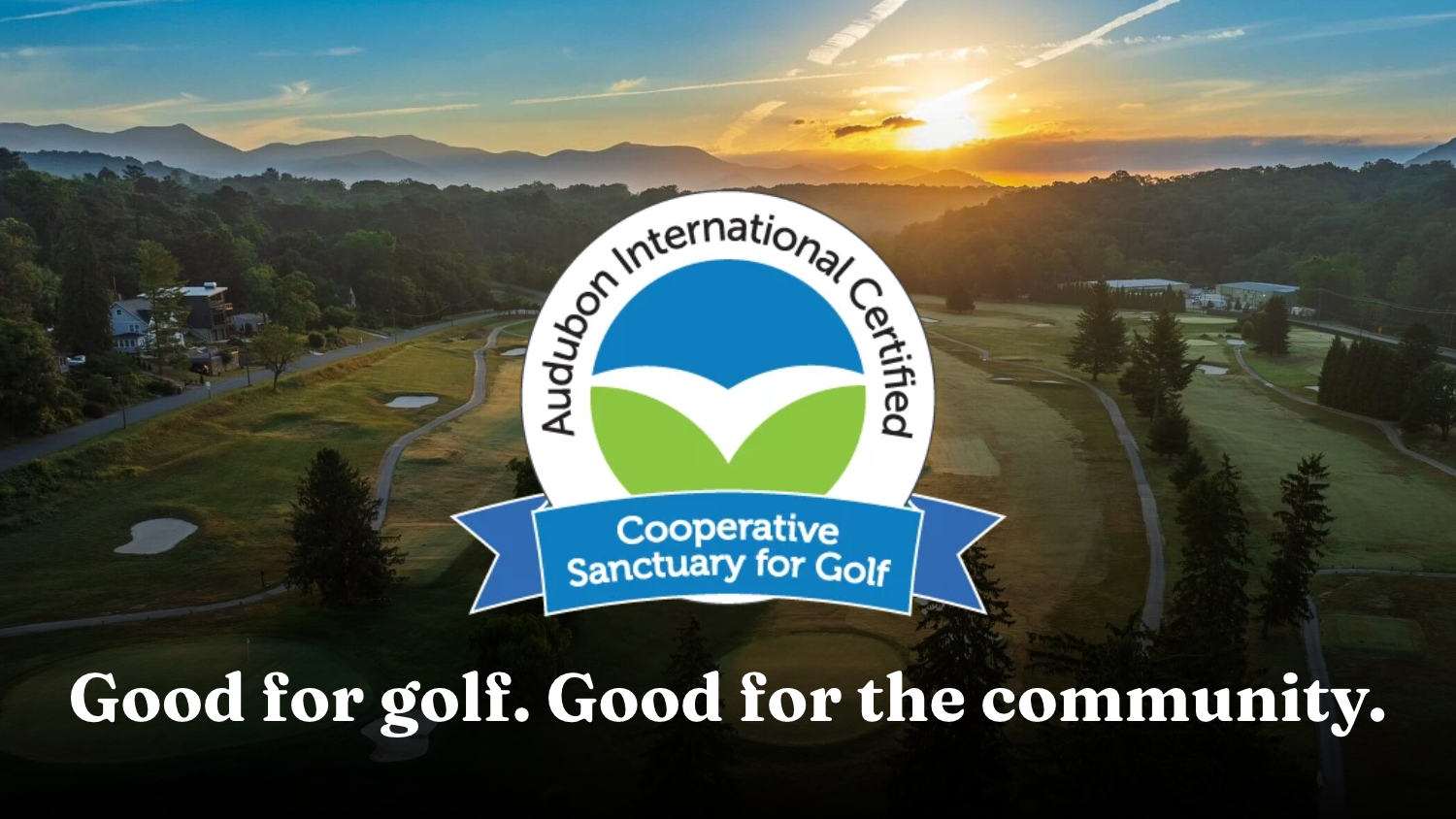
Asheville Municipal Golf Course is now a certified Audubon International Cooperative Sanctuary! The City of Asheville and Commonwealth Golf Partners announced it on October 28, after about 18 months of work by the course's grounds crew, its neighbors, and many volunteers. You can read the City's announcement here.
Many people share this one, and the Muni grounds crew is at the top of the list.
What it takes
Audubon International's Cooperative Sanctuary Program is built specifically for golf courses. A course registers, writes an environmental plan for its own property, and then has to prove its practices in five areas:
Wildlife and habitat management
Chemical use reduction and safety
Water conservation
Water quality management
Outreach and education
Proving it means paperwork most golfers never see. Maps, photos, pest management records, water test results, a running inventory of the property's wildlife, and samples of how the course teaches the public. Then an Audubon International staff member visits in person and walks the course before anything is final. Most courses take one to three years. Muni started in March 2025, and the course has to recertify every three years to keep it.
The crew did the hard part
"It would be extremely easy for us to have green grass by constantly running water and spraying whatever fungicide is on the shelf, but we do not do that," said superintendent Matt Dierdorff.
Instead, the crew uses soil sensors in the greens to decide when to water, and hand-waters where it counts. According to the City, that has cut the course's annual water use in half. A fertilizer plan built on frequent soil testing and weather forecasts has cut fertilizer needs by nearly 20 percent. It goes down only when the turf actually needs it. On top of that, the crew has spent the last year and a half pulling invasive species and bringing back native plants, including the low-mow native areas in front of the 13th, 14th, 15th, and 16th tees.
That approach takes more hand labor and more judgment calls. Some of the crew have been at Muni for years and had to relearn how to manage turf after doing it another way for a long time. They put in extra hours to get here.
So thank you to Matt Dierdorff, Cody Mincey, Amy Lane, Bo Summers, Phil Pekoske, Ace Tomkalski, Andrew Geller, Charlie Borque, Al Distefano and Jim Cope. Next time you see one of them out on the course, tell them. If you want to see what their mornings look like, WNC Golf Insider spent one with them this month.
Neighbors and volunteers
Audubon also asks a course to show it's part of its community, and Muni's community showed up. Beverly Hills neighbors, led by Melanie Bowen, saw the opportunity early. They secured City Neighborhood Matching Grant funds and a commitment from the FairWays Foundation for about 1.5 acres of native plantings, including the pollinator garden and kiosk above the 11th green and the planting between holes 13 and 14. Neighbors have planted, mulched, and weeded both.
FOAM volunteers worked alongside the Commonwealth staff for the whole 18 months. FOAM hosts the BioBlitz, a day spent counting everything that lives on the course. In 2025, 82 neighbors and golfers turned out, which placed Muni second in the world in Audubon International's community engagement category. Family Moth Night, held with the North Carolina Arboretum, drew more than 70 people who identified over 100 species after dark. Nancy Casey, the Beverly Hills Bird Lady, leads bird walks, and Scout Troop 4 built and installed birdhouses around the course. Audubon reviewed it all for the record.
Where FOAM fits
FOAM paid for the certification process from start to finish. That money came from FOAM members and donors, so if you're one of them, you helped make this happen - thank you!
It's the kind of support FOAM was started to give. The crew and the neighbors were already doing the work. FOAM made sure the cost of getting it recognized never stood in the way.
What it means
For Asheville, it means a public property on the Swannanoa River is using half the water and less fertilizer than it used to, giving more room to birds and pollinators in the middle of East Asheville. Muni is public land before it's anything else, and what happens on it reaches past the people playing that day.
For golf, it means a public course that opened in 1927, is still recovering from Helene, and runs on a small crew and a public budget meets the same standard that well-funded private clubs work toward. Good golf and good stewardship can share the same ground, at a course anyone can play.
Paul Bonesteel said it after the first BioBlitz: "It's still a golf course, of course! But it can be two things at once: a fun place to play the game we love, but also a place where nature can thrive."
If you want to be part of what comes next, join the Friends for $50 a year, and come count bugs and birds with us at next summer's BioBlitz.
